



Print

News


Vice President Biden tells Toledo Jeep crowd auto bailout a success Funds led to comeback, V.P. says in Toledo


Vice President Joe Biden and an array of Ohio Democratic politicians celebrated the comeback of the American auto industry in a tour and speech at Toledo's Jeep Wrangler assembly line Monday. 

The vice president said the recession that started in 2008 could have destroyed hundreds of thousands of jobs in the automobile industry if the government hadn't extended emergency loans to keep the companies afloat.

He said 431,300 auto-industry jobs were lost in 2008, but since General Motors Co. and Chrysler Group LLC emerged from bankruptcy last year, employment has rebounded by 76,300 jobs.

"It's a huge reversal and one we'd never have seen had we listened to those who told us to walk away," Mr. Biden said.

He noted a rise in auto employment and a return to U.S. shores of parts manufacturing that he said would not have been possible without the emergency bailouts made by taxpayers starting in December, 2008.

"The American auto industry is rebuilding itself, and I believe it will dominate the 21st century like it did the 20th," Mr. Biden said to a crowd of several hundred - mostly union autoworkers - in the factory.

The vice president played up his car connections, saying he once applied for, but didn't get, a job at a GM factory and that his father was a car dealer. He got one of his biggest cheers when he told the crowd that he's had a Jeep in his driveway continuously since 1973.

According to Mr. Biden, the country is seeing a trend toward "in-sourcing" - the return of parts manufacturing from overseas.

Last year, he said, fewer than 60 percent of the Wrangler's parts were made domestically. Now, that number is 78 percent, he said.

Mr. Biden said all three American car firms posted operating profits for the second quarter for the first time since 2004.

General Motors recently announced it would sell stock in the firm, of which the U.S. government owns about 60 percent. Mr. Biden said he didn't know if that would pay back the American taxpayer for their loan.

"I don't know that we get totally out of GM, but I think that [initial stock offering] is going to be successful," he said.

Mr. Biden got in some partisan shots at the previous administration, saying the main thing that he and President Obama wanted to do was "clear away the brush left by eight years of neglect ? by the last administration."

The vice president's trip continued on to a fund-raising event for Gov. Ted Strickland at Belmont Country Club in Perrysburg Township. About 75 people attended the event where ticket prices were $1,000 to $2,400 per person.

Mr. Strickland is facing a challenge from former Ohio congressman John Kasich, a Republican.

The Biden speech took place in what Chrysler calls its supplier park, a complex of three privately owned supplier plants on North Expressway Drive that feed parts to the Wrangler assembly plant, said to be one of only two such arrangements in the world.

Workers Kevin Durczynski, 43, of Oregon and Amy Vollmar, 44, of Tontogany, Ohio, showed the vice president how they attached windshields to Wranglers.

"Very easy-going, made me feel comfortable right away," Mr. Durczynski said of Mr. Biden.

He said he told the vice president, "We appreciate him and President Obama for passing TARP and allowing us to prove to the world that we make a world-class vehicle at the Toledo Jeep complex."

The Troubled Assets Relief Program, passed in October, 2008, was used for the government's extension of some $81 billion in loans to GM and Chrysler to keep them from a shutdown that was feared would have taken much of the supplier chain with them.

One of the dignitaries present was Sergio Marchionne, chief executive officer of Chrysler, which emerged from bankruptcy in June, 2009, under the management of Fiat SpA of Italy, of which he also is CEO. Mr. Marchionne said Chrysler Group would repay the taxpayers before 2014.

Asked how much money that would be, he said, "Whatever they lent us. We have all the cash they lent us. It's still with us."

Politicians who spoke were Mr. Strickland, Ohio U.S. Sen. Sherrod Brown, and U.S. Rep. Marcy Kaptur of the 9th Congressional District, which includes Toledo. Lt. Gov. Lee Fisher attended but did not speak.

Miss Kaptur, who is challenged by Republican Rich Iott of Monclova Township, thanked Mr. Biden and Mr. Obama for their "courage" in extending funds to GM and Chrysler.

"There were some who said we should walk away from plants like this one," she said, recalling that the House voted 237-170 in December, 2008, to provide bridge loans, with overwhelming Democratic support and GOP opposition. "Who would vote no on billions of dollars of investment in Ohio and Michigan, the heart of the United States auto industry? We thank those who had the courage to do that."

Miss Kaptur said the auto market is "rigged" against U.S. manufacturers in other countries that sell their cars here unhindered, but bar U.S. cars sales at home.

"We ask our workers and our manufacturers to compete against closed markets," Miss Kaptur said. She said Korea sells 700,000 cars in this country, but only 7,000 American cars are sold in Korea.

Mr. Iott has said he opposes the bailout of GM and Chrysler, saying last week that it was wrong for the government to pick winners and losers in the economy.

Monday, Mr. Iott issued a statement highlighting the success of Ford Motor Co., which occurred without taxpayer aid.

"Without government aid, [Ford] made painful cuts and is today thriving without the burden of billions in federal bailout loans and without Washington bureaucrats breathing down its neck," Mr. Iott said.

U.S. Rep. Bob Latta (R., Bowling Green) said in a news conference by phone that the economy is not as rosy as the administration portrays it, and the reason is that Mr. Obama's policies on debt, taxes, health care, environmental legislation, and regulation are creating uncertainty.

"With the vice president coming today, and again you have to ask yourself where are the jobs at," Mr. Latta said, adding that Ohio has lost 130,000 jobs since the stimulus passed in early 2009.

Mr. Latta voted against the TARP legislation for the auto manufacturers. He said Monday the government moved too fast and should have given the market more time to correct itself.

"What people want to see is government really getting off their back and letting them go out there and create jobs," Mr. Latta said
top

An Improved Chrysler Is About to be Tested

By: Phil LeBeau
CNBC Correspondent

Give Chrysler CEO Sergio Marchionne and his management team credit. The patient is no longer on it's death bed. In fact, if you look at Chrysler's second quarter financial results you see a nice improvement.

Sure, the company is still losing money ($172 Million), but that's an improvement over the first quarter and it once again posted an operating profit ($183 Million). Meanwhile, it's cash position jumped to $7.8 Billion. Thanks to an improving auto market and higher volumes, Chrysler is doing better.

Sergio Marchionne
Getty Images
Sergio Marchionne

But don't be fooled. These numbers show a company that has been stabilized. As Marchionne himself will point out, the American automaker still has a long ways to go. Which is why the second half of this year will be critical to the Chrysler turnaround.

Between now and the end of the year Chrysler will roll out 15 new and refreshed models, to join the revamped Jeep Grand Cherokee. These are the horses Chrysler needs to ride if its sales (and profits) are going to improve.

If Chrysler does as as well with these new models as it has done so far with the Grand Cherokee, then the second half will be the inflection point people have been waiting for.

The Grand Cherokee is a dramatic improvement over the old model, and the early reception has been solid. Now the company needs to get the same reaction from the Jeep Compass, Jeep Patriot, Dodge Caliber and Jeep Wrangler refreshments. But that's just the start, before the end of the year, we'll see a new Dodge Durango and the first versions of the Fiat 500 will start rolling into dealerships. That's a lot of new product in a short period of time.

But in many ways, the new models can't come soon enough. Have you visited a Chrysler dealership in the last six months? These guys are starved for new products. In the last three years they've been trying to win over buyers with big incentives, and little else. So as Ford and General Motors dealers have had a steady supply of new models to attract customers, Chrysler dealers have had to sit and wait.

So while it's encouraging to see Chrysler improving its balance sheet, lets keep it in perspective. Until now, the challenge for Chrysler has been stemming the losses and setting the stage for a comeback.

Starting later this month and then through the end of the year, we'll see whether Chrysler has the goods to once again show American buyers they should keep the smallest of the big three on their shopping list.

top

Chrysler Invites Dealers to Attend Fiat Experience on Aug. 30


In a move to strengthen its franchise network in 119 U.S. markets for the upcoming Fiat models, Chrysler Group, LLC. has recently written letters to more than 600 auto dealers inviting their application to sell Fiat cars. The dealers have also been requested to attend the "Fiat Experience" on Aug. 30, where they will be exposed to the new franchise requirements vis-à-vis new opportunities. According to Chrysler release, the 119 markets have "strong small-car registrations and growth potential in the small-car segment over the next five years."

The Fiat Experience program is scheduled to take place on Aug. 30 in Detroit. Ahead of the franchise-promotional program, Chrysler's vice president of network development and fleet Peter Grady and Fiat North America's head Laura Soave are seen busy contacting potential dealers for bringing them in the Fiat chain, says a media report. According to a Chrysler release, interested dealers may submit their proposals by Sept. 22 and the automaker is likely to finalise the Fiat franchisees by early October.

"The requirements for Fiat are straightforward: separate sales and display at launch, transitioning to a full dealership facility as the volume grows," says Grady in a statement.

The Fiat 500 minicar will be the first vehicle to go to the dealers. Production of the vehicle is planned to start in the fourth quarter in Toluca, Mexico. Three more 500-based models are in pipeline to hit market by 2013. The dealers may also expect Alfa Romeos to join their lineup in 2012, though no concrete statement was made by either side in this regard. Ralph Kisiel, Chrysler spokesman, only said the Fiat network "might be expanded as more new products are added to the lineup."

Kisiel has further added that Fiat franchises may go to non-Chrysler dealers if suitable Chrysler dealers are not found in a given market.

via autonews; image via ramsdenandpartners

top

Detroit Goes From Gloom to Economic Bright Spot

DETROIT - After a dismal period of huge losses and deep cuts that culminated in the Obama administration's bailout of General Motors and Chrysler, the gloom over the American auto industry is starting to lift.

Jeff Kowalsky for The New York Times

Jobs are growing. Factory workers are anticipating their first healthy profit-sharing checks in years. Sales are rebounding, with the Commerce Department reporting Friday that automobiles were a bright spot in July's mostly disappointing retail sales.

The nascent comeback is far from a finished product. Foreign competitors are leaner and stronger, accounting for more than half of all car sales in this country. The sputtering economic rebound is spooking investors and consumers alike, threatening to derail some of Detroit's gains. And talks next year on a new contract with the United Automobile Workers could revive old hostilities.

Still, the improving mood here reflects real changes in how Detroit is doing business - and a growing sense that the changes are turning the Big Three around, according to industry executives and analysts tracking the recovery.

Ford made more money in the first six months of this year than in the previous five years combined. G.M. is profitable and preparing for one of the biggest public stock offerings in American history. Even Chrysler, the automaker thought least likely to survive the recession, is hiring new workers.

Many of the excesses of the past - overproduction, bloated vehicle lineups, expensive rebates - are gone. All three carmakers have shed workers, plants and brands. And a new breed of top management - the three chief executives are outsiders to Detroit, as is the newly named G.M. chief executive - says it is determined to keep the Big Three lean, agile and focused on building better cars that earn a profit.

"What we've come out of this with," said Sergio Marchionne, who runs both Chrysler and its Italian owner Fiat, "are much more rational, more grounded players making moves for the long term."

The proof is emerging in dealer showrooms, where customers are buying more of Detroit's cars and paying higher prices. In July, G.M., Ford and Chrysler sold their vehicles at an average price of $30,400 - $1,350 more than a year ago and higher than an overall industry gain of $1,100, according to the auto research Web site Edmunds.com.

With fewer factories churning out products, inventories are smaller and sales incentives like rebates and low-interest financing are gradually declining. "They were nibbling at these issues before, a little bit here and a little bit there," said Jeremy Anwyl, Edmund's chief executive. "It's just different now that they are in fighting shape."

Detroit has vowed to change before, slimming down when sales slumped or pouring resources into vehicle quality to catch up to foreign competitors. Those efforts stalled or failed. But many auto analysts say the current makeover has a more permanent feel, largely because of the presence of the outsiders at the top and the lessons learned from the near-death experience of last year's bankruptcies at G.M. and Chrysler.

Ford's chief executive, Alan R. Mulally, broke the mold four years ago when he came from Boeing and set out to streamline Ford's bureaucracy and integrate its worldwide operations. At G.M., Edward E. Whitacre Jr., a former AT&T chief, has replaced dozens of top officials with outsiders and younger executives, and driven the company to make decisions faster. Those efforts are likely to be accelerated under Daniel F. Akerson, who was named on Thursday to succeed Mr. Whitacre as chief executive in September.

And at Chrysler, Mr. Marchionne, an Italian raised in Canada who is both a lawyer and an accountant, is systematically upgrading the carmaker's aged product lineup and revamping its plants in Fiat's image.

"Fundamentally this thing has been reshaped, resized and rethought," Mr. Marchionne said of Detroit. The biggest difference, he said, is that the Big Three have finally broken the habit of reflexively raising incentives to increase sales volumes.

"We're not trying to kill each other for this month's market share," he said. "Those days are over. We're not offering $7,000 checks to try to sell a car."

Wave after wave of plant closings and worker buyouts in recent years has brought Detroit's production more in line with the demand for its vehicles. Since 2000, the number of Big Three assembly plants in North America has dropped to 40, from 66, according to the consulting firm Oliver Wyman. In turn, overall capacity has shrunk to about eight million vehicles a year, from 13.7 million.

That still may be too much. After several years of sales topping 16 million vehicles, the industry nosedived to 10.4 million last year - the lowest since 1982. At current levels, sales are projected to edge up to about 12 million this year, with Detroit's share running at 46 percent.

"They carved out a lot of capacity, but I'm not sure it was enough," said Peter Morici, an economist at the University of Maryland. "There's still an excess."

Even under the most hopeful assumptions, a resuscitated United States auto industry in the end would account for less than 3.5 percent of the country's economic output, economists estimate, compared to 4.6 percent in the late 1970s. But the Obama administration, which argues that the comeback is long-term and sustainable, contends that the Big Three have downsized enough to be profitable with fewer sales.

"They were just barely making money or breaking even in a market of 16 to 17 million a year," said Brian Deese, a member of President Obama's auto task force. "The companies are positioned now to move forward in an environment of 11 to 12 million in sales."

Some Republicans and other critics of the administration are less bullish, and suggest it is too early to know if the restructuring will stick or how much credit the federal assistance is due. That debate will likely play out in the November midterm elections, but in the meantime some of the raw numbers are falling Detroit's way.

The bankruptcies at G.M. and Chrysler slashed debt, jobs and labor costs, and revised union contracts have brought manufacturing expenses more in line with factories in this country operated by Toyota and other foreign automakers.

The average production worker at G.M. earns $57 an hour in wages and benefits, compared to $51 at Toyota, according to a study by the Center for Automotive Research in Ann Arbor, Mich.

Those costs should continue to fall as the companies hire new workers at lower pay grades agreed to by the U.A.W.

"What's come out of this crisis is a realization that the interests of both sides are aligned," Harley Shaiken, a labor professor at the University of California, Berkeley, said of workers and management.

That alignment could be tested next year when the Detroit companies negotiate a new contract with the U.A.W. The union's president, Bob King, has vowed to get back some of the concessions made in the bankruptcies.

For now, though, the industry is adding jobs for the first time in a decade. More than 330,000 jobs were lost by the American automakers and their suppliers in 2008, White House officials said, while 55,000 jobs have been added since Chrysler and G.M. emerged from bankruptcy in the summer of 2009.

Chrysler, which cut more than half its work force since 2005, has added 3,100 jobs this year, including white-collar jobs at its headquarters in suburban Detroit. The company is recruiting again on college campuses and bringing in entry-level engineers and managers.

One of the first new hires was James Kim, an electrical engineer who recently graduated from the University of Michigan. Mr. Kim also had job offers from Verizon and other companies.

"I saw an opportunity to get into a company that was rebuilding itself from the ground up," said Mr. Kim. "It's almost like going to a start-up business."

Another new white-collar worker, Davida Redmond, joined Chrysler after taking a buyout from Caterpillar. "I felt like the worst was over in Detroit," she said. "The storm is behind us."

But for the recovery to last, some economists say, several things need to happen, including continued improvements in quality, a relentless focus on cutting costs - and some luck on the economy's overall strength.

"Their recovery is not sustainable yet," said Mr. Morici, the economist. "They need to reduce their costs more if they're going to be competitive in the long term with the Japanese, the Koreans and ultimately the Chinese."

Top management says it is well aware of the rough patches ahead. "We still have important work to do," said Mr. Akerson, the incoming G.M. boss.

Even so, optimism is building in the offices and plants and engineering labs of the Detroit companies, employees say. And promising new electrified vehicles like the Chevrolet Volt and small cars like the Ford Fiesta are slowly changing consumer perceptions that the Big Three are behind the times.

"It wasn't long ago that people had just written them off," said Mr. Shaiken, the labor professor. "But they live to fight another day."

top

Chrysler to spend $27 million on Toronto parts plant, preserving 280 jobs

Kristine Owram, The Canadian Press

TORONTO - Chrysler Canada is spending $27.2 million on new technology for its auto parts casting plant in Toronto, preserving the factory's 280 jobs.

The plant in the Toronto suburb of Etobicoke, which currently produces aluminum die castings and pistons, is being prepared to make vehicle suspension parts called crossmembers starting in the third quarter of 2011, Chrysler said Thursday.

"We welcome this investment in the Etobicoke Casting Plant as it is an acknowledgment of the high-quality components produced by our skilled workforce for many years," stated Michael Butz, manager of the west-end plant.

"Being able to expand our part portfolio better aligns with Chrysler's long-term product strategy, which ensures the future for this facility," he added.

Canadian Auto Workers president Ken Lewenza said he was "thrilled" with the investment.

"This will help preserve and enhance jobs in the city and give a greater measure of security to our members and their families well into the future," he said.

Chrysler currently employs about 7,500 people at assembly plants in Brampton and Windsor, Ont., as well as the Etobicoke casting plant.

The Brampton plant, northwest of Toronto, has been the source of much speculation ever since Chrysler LLC emerged from U.S. bankruptcy protection with the help of its new partner, Italian automaker Fiat.

Rumour has it the plant will begin building a small number of Fiat's Lancia-brand luxury vehicles beginning in 2012.

Fiat CEO Sergio Marchionne, who took the reins at Chrysler last year after the Italian automaker took a controlling stake in the struggling company, is notoriously secretive about his product plans.

But Marchionne has said he hasn't ruled out manufacturing Fiats in Brampton, including Alfa Romeo-brand vehicles. The Brampton plant currently builds the Chrysler 300C, Dodge Challenger and Dodge Charger. It's running on two shifts and has about 800 workers on layoff.

Fiat took a controlling stake in Chrysler last year while the struggling U.S. company was restructuring.

The agreement aimed to provide Chrysler with the small vehicle technology it lacked, while Fiat would get access to the North American marketplace through Chrysler's distribution system.

In April, Marchionne said he hoped that the combined Chrysler-Fiat would build six million cars annually by 2014 with revenues of US$86.3 billion.

top

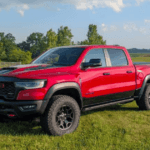
2010 Ram 1500 Laramie pickup

By Ron Amadon, MarketWatch

GREAT CACAPON, W. Va. (MarketWatch) -- Rolling along for miles on Interstate70 to get to some great off-road running, it was hard to believe that this was a big ole' American pickup.

The leather-trimmed bucket seats were such that the trip could well have been extended to Alaska. They were 10-way-adjustable with power lumbar, and easy on the back. There was an abundance of head, shoulder, leg and every other kind of room. Two real adults would be quite comfy in the (heated) rear seats of this Dodge Crew Cab model, something I seldom get to say about any vehicle any more, it seems.

The interior was serene as the big V-8 loafed along at legal highway speeds of 65 mph and a bit above that. There were luxury touches everywhere and it was easy to believe that this was not a truck, but a luxury car -- although a rather large one. Acceleration was more than adequate.

The A/C and ventilated front seats easily offset the record-breaking hot and humid weather that seems to have declared the mid-Atlantic region as its home this summer. The 500-watt Alpine surround sound audio system sounded wonderful on satellite channels and on the Willie Nelson CD that also made the trip. (Come on, who else ya gonna listen to on a long day in a pick up?) And the 30 gig hard drive will store 6,700 of your favorite tunes.

Winding over the snake-like curves and ups and downs of Route 9, the large size of this truck was apparent, but not an impediment. Ain't no mountain high enough where there is a 5.7-liter, 390 horsepower Hemi V-8 under the hood that bats out 407 lb-ft of torque at 4,000 rpm. It was matched to a 5-speed automatic in the test truck and EPA rated at 13-18 mpg. I got 15 on the trip, but that included miles of slower speed running on what was once a railroad road bed. The Ram likes mid-grade gas.

The heavy duty engine cooling did its thing on this day of 90-plus degree temperatures and the Electronic Shift on Command transfer case got a workout too, with nary a spun tire, thanks in part to an anti-spin differential rear axle.

Even on steep hills with lose dirt and rocks, the Ram simply seem to say, "Oh come on, this is no real challenge."

By the way, Chrysler /quotes/comstock/23g!f (IT:F 9.80, +0.04, +0.41%) got a brilliant idea to use the otherwise wasted space on either side of the truck bed as lockable storage. You can keep beverages cold there, and then pull a plug to let the melted ice run out. Brilliant, I say!

Even along heavily potholed former roadbed, the ride was never punishing, thanks to the coil-spring rear suspension, and not the leaf-spring suspension used by so many truck makers.

The size does make itself known when you head out to the supermarket or shopping center and want to park. It is easier to head for the back 40 where it is less crowded, and besides, the exercise is good for you.

How big is the Ram? A total of 229 inches long, 79.4 wide and 75 inches tall. It is a big step up to enter the cab for shorter folks, with the truck's 9.6 inches of maximum ground clearance.

The test truck would carry 1,430 pounds of cargo and tow a 7,000 pound trailer. It cost us (gulp) $65 to fill it up at trip's end when it was running on fumes.

Yet there was never a time when I didn't look forward to driving the Ram, once called a Dodge, pickup. It was always fun and turned more than few heads out here in pick up truck country.

With $3,580 worth of options including the transportation charge, the test truck carried a bottom line of $46,320. Less expensive Rams can be had, of course.

If the Ram lasts as long and is as trouble free as the much loved Dodge Dakota pickup I owned, owners will build up a fond affection for this big truck. After all, it was introduced during a cattle drive down the streets of Detroit.

Hubcaps

New acquisitions Land Rover and Jaguar helped India's Tata motors post a $428-million quarterly profit, where there had been a loss a year earlier.

Ford is closing out the venerable Crown Victoria, which made me wonder what taxi drivers will be herding us around in.

About 600 dealers have been invited to Chrysler headquarters in Auburn Hills, Mich. The Detroit News reports they will be briefed on what will be needed if they want to sell the parent firm's Fiats in this country.

Kelley Blue Book named the Honda Civic as the best back to school car, followed by the new Ford Fiesta. The Mazda 3 came in third. And the impressive new Chevy Cruze also made the list

Vehicles tested in this column are on loan from the auto companies through local distributors.

Ron Amadon is an auto writer and morning news anchor on the MarketWatch Radio Network, based in Washington, D.C.

Ron Amadon is an auto writer and morning news anchor on the MarketWatch Radio Network, based in Washington.

top

Bookmark and Share

News and Events

Vice President Biden tells Toledo Jeep crowd auto bailout a success Funds led to comeback, V.P. says in Toledo
By TOM TROY BLADE POLITICS WRITER Vice President Joe Biden and an array of Ohio Democratic politicians ...
An Improved Chrysler Is About to be Tested
By: Phil LeBeau CNBC Correspondent Give Chrysler CEO Sergio Marchionne and his management team credit. ...
Chrysler Invites Dealers to Attend Fiat Experience on Aug. 30
 
Detroit Goes From Gloom to Economic Bright Spot
By BILL VLASIC Published: August 13, 2010 DETROIT - After a dismal period of huge losses and deep cuts ...
Chrysler to spend $27 million on Toronto parts plant, preserving 280 jobs
Kristine Owram, The Canadian Press TORONTO - Chrysler Canada is spending $27.2 million on new technology ...
2010 Ram 1500 Laramie pickup
By Ron Amadon, MarketWatch GREAT CACAPON, W. Va. (MarketWatch) -- Rolling along for miles on Interstate70 ...